


Seismic Pipe Support Systems: The 7 Most Common Mistakes in MEP Seismic Design (and How to Avoid Them)
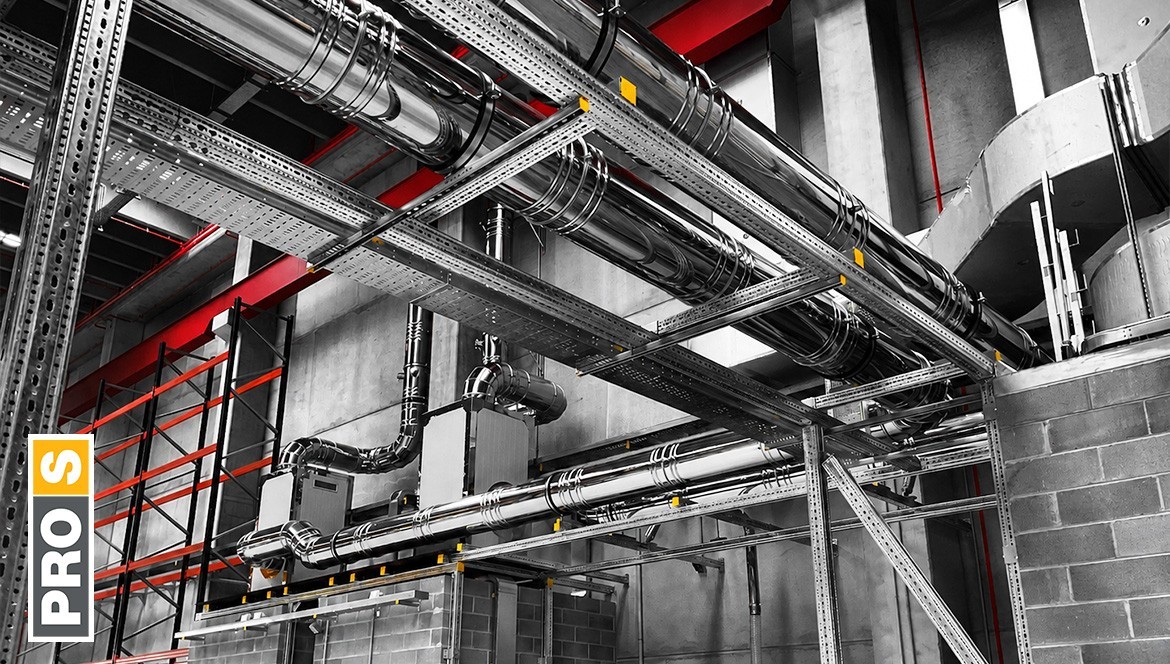
When it comes to seismic design, attention is often focused on the structural elements of a building. However, MEP systems also play a crucial role in ensuring the overall safety and functionality of a facility.
Piping, cable trays, ventilation ducts, HVAC systems and other building services are classified as non-structural elements. During an earthquake, however, they can experience significant movement. If they are not properly supported, they may fail, lose their anchorage or compromise the building's functionality, resulting in both economic losses and safety risks.
The Italian Technical Standards for Construction (NTC 2018) place particular emphasis on non-structural elements and building services, highlighting the importance of designing these systems to withstand seismic actions.
In practice, many critical issues are not caused by poor-quality components, but by design, coordination or installation mistakes that reduce the effectiveness of the entire support system.
Regulatory framework: what do the Technical Standards for Construction require?
The main Italian regulatory reference is the Ministerial Decree of January 17, 2018 – Technical Standards for Construction (NTC 2018), supplemented by Circular No. 7 of January 21, 2019.
According to the NTC, non-structural elements and building services must be designed so that their capacity exceeds the expected seismic demand, preventing them from becoming a hazard to occupants or affecting the building's operational performance.
Section 7.2.3 defines the design criteria for non-structural building components, while Section 7.2.4 specifically addresses the seismic design of MEP systems.
One aspect that is often overlooked is the calculation of the seismic demand acting on non-structural elements. The NTC introduces the concept of horizontal seismic force (Fa), determined as a function of seismic acceleration (Sa), the weight of the element (Wa) and the behaviour factor (qa). This evaluation is essential for correctly sizing support systems and seismic bracing.
The responsibilities of the designer, supplier and installer
The design of seismic support systems is not the responsibility of a single party. It is the result of a coordinated process involving several professionals, each with clearly defined responsibilities.
The Technical Standards for Construction state that the seismic safety of MEP systems depends on effective collaboration between the structural designer, supplier and installer.
The structural designer determines the seismic demand by defining the loads that will act on the MEP systems and their support structures.
The supplier provides components with mechanical characteristics that meet the design requirements while supporting the customer through technical documentation, engineering calculations and specialist consultancy.
The installer is responsible for the correct installation of the support system. Compliance with the design, specified spacing, fixing methods and installation instructions is essential to ensure that the system performs as intended.
Ultimately, seismic safety is achieved through the collaboration of all parties involved. Only an integrated approach can ensure a safe, reliable and code-compliant installation.
Let's now examine the seven most common mistakes.
1. Treating seismic bracing as the final stage of the project
One of the most common mistakes is addressing seismic supports only after the MEP systems have already been installed.
At that point, available space is already constrained, penetrations have been completed and the possibility of correctly installing seismic bracing is often limited.
Instead, seismic support systems should be designed during the early stages of the MEP project, allowing designers to identify anchorage points, detect clashes and optimise installation time and costs from the outset.
2. Assuming every MEP system requires the same solution
Every installation has different characteristics.
A suspended pipeline, a cable tray, a ventilation duct or an HVAC unit all respond differently to seismic loads and therefore require dedicated engineering verification.
Factors such as system weight, building location, installation layout and supporting structure also influence brace sizing. For this reason, there is no universal solution suitable for every application.
3. Underestimating the importance of anchors
A seismic bracing system is only as strong as its weakest component, and anchorage is often the most critical element.
Profiles, threaded rods and braces may all be correctly designed, but if the connection to the slab or supporting beam is not properly verified, the entire system becomes ineffective.
The design process must therefore consider the complete load transfer path, from the support components to the building structure.
4. Failing to properly evaluate seismic loads
Seismic support systems cannot be designed based solely on the weight of the installation.
Seismic actions depend on several factors, including the seismic zone, building characteristics, system location and the dynamic interaction between the structure and the MEP installation.
This is why specific engineering calculations are essential to identify the most suitable solution for each project.
5. Overlooking clashes between MEP systems
Modern buildings contain mechanical, electrical, plumbing and special systems operating within the same spaces.
During an earthquake, each installation requires sufficient clearance to accommodate expected movements without colliding with adjacent systems.
A coordinated design process identifies these potential clashes early, avoiding costly on-site modifications and improving installation quality.
6. Relying solely on on-site experience
The installer's experience is extremely valuable, but it cannot replace engineering design.
Even a perfectly installed support system may fail to meet the required performance if it has not been properly designed and verified according to applicable standards.
Engineering and installation must therefore work hand in hand.
7. Believing that code compliance is enough
Meeting the requirements of the NTC is the starting point—not the final objective.
The true purpose of seismic support systems is to minimise damage to MEP installations, reduce risks to occupants and maintain the operational continuity of the building after an earthquake.
Experience gained from numerous seismic events has shown that inadequate design of supports, anchors and fastening systems can lead to significant economic losses and serious safety consequences.
Conclusion: an integrated approach makes the difference
An effective seismic support system begins long before installation.
Preliminary analysis, load verification, component selection, anchorage design, on-site assistance and final inspection are all parts of a single engineering process.
This is the approach adopted by PROSYSTEM, supporting designers, installers and contractors throughout every stage of the project—from the initial site survey and engineering verification to the design of the seismic support solution, on-site technical assistance and final inspections.
In Same Category
- Summer and Thermal Expansion: When Pipe Support Systems Make the Difference
- Fastening SiFramo profiles with FLS self-tapping bolts: essential rules for a safe connection
- Correct Installation of WBD Plates with Anchors
- Design of Supports for Fire Protection Systems in Seismic Areas: Regulatory Approach, Technical Criteria, and Responsibilities
- RAL certification for support systems